Two years ago, that search gave them a couple of sponsored ads at the top, then ten blue links to work through. They’d click five or six sites, form their own opinion, and maybe fill in a form.
That’s no longer the only way it happens.
Now, depending on the query, Google may show an AI Overview near the top of the results. It can answer the question directly and surface links to the sources behind that answer.
When one does appear, it can shape which builders the homeowner investigates before they ever reach the traditional results.
So the question you need to be asking has changed. It’s no longer where do I rank?
It’s am I even getting mentioned?
You’re Not Just Being Ranked Anymore.
You’re Being Recommended.
Your whole career has run on word of mouth. Someone at a barbecue says “you should talk to Dave, he did our place,” and three weeks later you’re standing in a kitchen with a tape measure.
The machine is doing that job now. Only it doesn’t remember the beautiful job you finished in 2019. It has no loyalty to you and no idea you exist unless it can read your site, work out what you do, and trust you enough to put your name forward.
That’s a very different game to the one most builders have been playing.
And No, This Isn’t A Someday Problem
Two numbers you should know about.
The first: 70% of consumers say they’re using AI tools more than they were a year ago. Only 17% say they’re using traditional search less. In other words, Google hasn’t disappeared. People have simply added another place to ask questions, compare options and decide who deserves a closer look.
The second, and this is the one that should get your attention: the reports we’re watching put AI-driven traffic at up to nine times the conversion rate of traditional search traffic.
The reason makes sense once you see how the search itself has changed.
Someone who types “builder Wagga” is browsing. Someone who asks “who can build a passive-standard home on a sloping block in Wagga for around $1.2 million?” has already told the machine their budget, their block, their standard and their intent, all in one sentence.
So traditional search isn’t vanishing. The way people discover and shortlist builders is expanding. And when AI is part of that process, being one of the names it puts forward suddenly matters.
For Twenty Years You’ve Been Writing For Two Readers.
There’s Now A Third.
Everything you’ve ever put online was written for two readers. People, and search engines. That’s it. Two entities, and every decision about your website came down to keeping both of them reasonably happy.
There’s now a third reader.
Not a person. Not a search engine. An answer engine. ChatGPT, Perplexity, Google’s AI Overview, reading your site not to rank it, but to work out whether to quote you.
That third reader behaves nothing like the other two. A person skims. A search engine indexes keywords. An answer engine hunts for a clear, specific answer it can lift straight off your page and stand behind. If it can’t find one on your site, it finds one on somebody else’s and recommends them instead.
That’s the whole difference between SEO and AEO, answer engine optimisation. SEO is about getting found. AEO is about getting cited.
And once you know you’re writing for a third reader, four things change:
1. You benchmark before you touch anything. Pages indexed. Keywords ranking. Keywords on page one. AI Overview appearances. Local pack listings. Knowledge panel keywords. Write the numbers down, then look at them again in three, six and nine months. Not because the numbers are exciting, but because you can’t tell whether anything’s working if you never wrote down where you started. Every builder we’ve ever benchmarked has been surprised by at least one of those six figures.
2. You write your FAQs around the prompts people actually use. So instead of “How much does it cost to build per square metre?” you’re answering “How much does it cost to build a double-storey extension on a sloping block in Melbourne’s inner east with a rendered façade?” Then you answer it properly. More specific, more conversational, longer. That’s how we approach FAQ content for the third reader.
3. You build cornerstone content, not a pile of unconnected blogs. Our approach is one substantial piece of 1,500 to 2,000 words on a subject you genuinely own, then four or five shorter posts of 400 to 600 words, each standing on its own but linking back into the big one. Those numbers aren’t an AI rule. They’re how we structure enough depth around a subject to answer the broader question and the specific ones around it. Someone lands on a small one, gets their question answered, clicks through to the big one. Every extra minute and every extra page tells all three readers the same thing. This is an authority site.
4. You go back to the Google Business Profile you set up once and never touched again. Reviews, photos, blog posts, social posts, products, the right phone number, an easy way to get hold of you. Maybe one in five business owners actually bothers, because most of us assume setting it up was the job. Our saying is: play the game with Google, and Google will play the game with you. AI is increasingly pulling location, availability and service information straight out of that profile.
Do those four things and you stop competing for one position and start competing for five: AI Overview at the top, then local pack, knowledge panel, people also ask, and image pack. Every one of them comes down to the authority of your business, as seen by Google and AI.
They Were Already Ranking Well.
They Still Weren’t Getting Mentioned.
Blue Eco Homes have been building in the Blue Mountains for 23 years. More than 55 industry awards between them. HIA NSW Professional Small Builder nine times in eleven years, and the national HIA Australian Professional Small Builder/Renovator title this April.
Not a builder with a marketing problem you could see.
We benchmarked them before touching a thing. 89 pages indexed. 318 keywords ranking. But zero AI Overview appearances, four local pack listings, one knowledge panel keyword.
Three months after the rebuilt site went live:
- AI Overview appearances: 0 → 6
- Local pack listings: 4 → 13 (+225%)
- Knowledge panel keywords: 1 → 6 (+500%)
- Pages indexed: 89 → 116
Those are our numbers. What matters is what they did to the phone.
The enquiry count didn’t move at all. Not one Google ad, not one Facebook ad, not a dollar of lead-gen spend. What changed was who was ringing, and how much they already knew before they did.
Read the full Blue Eco Homes case study
Bottom Line: All The Trimmings In The World
Won’t Save A Bad Foundation
You know this better than we do. You can’t build a stellar home with all the trimmings sitting on a dodgy foundation. Get the foundation right and everything you put on top of it holds. Get it wrong and the finishes don’t save you.
A website is no different. The AI Overview appearances, the local pack listings, the citations, they’re all trimmings. They only turn up when the thing underneath is properly built, properly structured, and fed with content over time.
The reason to start now is simpler than that. These results don’t appear the day a new page goes live. With Blue Eco Homes, we measured the change three months after the rebuilt site launched. The site had to be built, published and indexed before those gains could show up. So if you want to be more visible when homeowners start asking these questions later, the work needs to be there first.
Back To That Couple At The Kitchen Bench
They’re still sitting there. Nine o’clock, iPad, one question typed in.
In a second or two they’re going to get an answer, and that answer is going to name two or three builders in your area. Not the best three. The three the machine could read, understand and trust enough to put forward.
That’s the whole thing. You’re no longer trying to climb a list. You’re trying to be the name that comes out of the machine’s mouth when somebody asks it who to call.
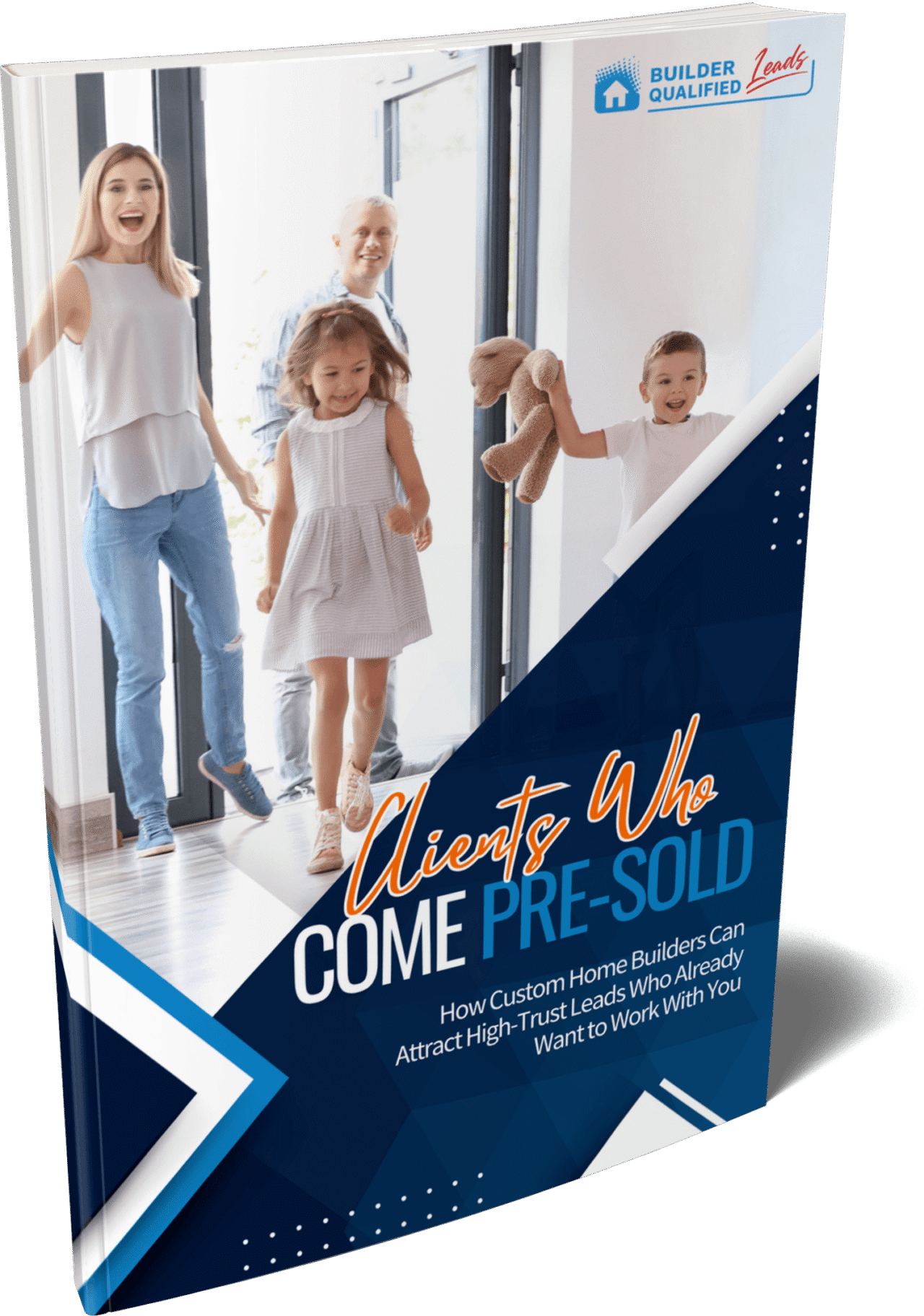
Getting named is half of it. The other half is what those people find when they come looking, so they turn up already convinced. That’s what we put this guide together for:
The Secret To Getting Clients Who Come Pre-Sold
Inside, you’ll find:
- The new rules of builder lead generation (and why ignoring this will keep you stuck with price-shoppers and tyre-kickers)
- The surprising 30-piece content rule that can 8x your conversion rate for custom builds and major renos
- The 3 tiers of leads (and why most builders waste their budget targeting the wrong two)
- How to stop chasing clients and start educating serious, design-ready buyers who value your process
- The Proven Marketing Eco-System Blueprint that turns cold strangers into pre-sold, high-trust clients who show up saying, “We’ve already decided we want to build with you.”
Download it, take your time flicking through, and if you’d like some help putting it into action, we’ll be here.
Frequently Asked Questions
What is answer engine optimisation (AEO), and how is it different from SEO?
SEO is about getting found in a list of results. AEO, answer engine optimisation, is about getting cited: writing your site so an AI answer engine like ChatGPT, Perplexity or Google’s AI Overview can lift a clear, specific answer straight off your page and put your name forward. SEO gets you ranked; AEO gets you recommended.
Are homeowners really using AI to find builders?
Increasingly, yes. Around 70% of consumers say they use AI tools more than they did a year ago, while only 17% say they use traditional search less. Google has not disappeared; people have simply added another place to ask who the best builder is, compare options and decide who deserves a closer look.
Why does AI-driven traffic convert better than traditional search?
Because the person has already told the machine what they want. Someone typing “builder Wagga” is browsing, but someone asking “who can build a passive-standard home on a sloping block in Wagga for around $1.2 million?” has shared their budget, block, standard and intent in one sentence. Reports we track put AI-driven traffic at up to nine times the conversion rate of traditional search.
How do I get my building business mentioned by AI?
Four things move the needle: benchmark your current visibility first, write your FAQs around the specific, conversational prompts people actually type, build cornerstone content (one substantial piece with several shorter posts linking into it) rather than scattered blogs, and fully complete your Google Business Profile. Together they build the authority an answer engine needs before it will name you.
How long does it take to see AI search results?
Not overnight. The site has to be built, published and indexed before the gains show up. With Blue Eco Homes we measured the change three months after their rebuilt site launched, when AI Overview appearances went from 0 to 6 and local pack listings rose 225%. If you want to be visible when homeowners start asking, the work needs to be in place first.